Downtown
Trinity Cathedral yard
Downtown churchyard
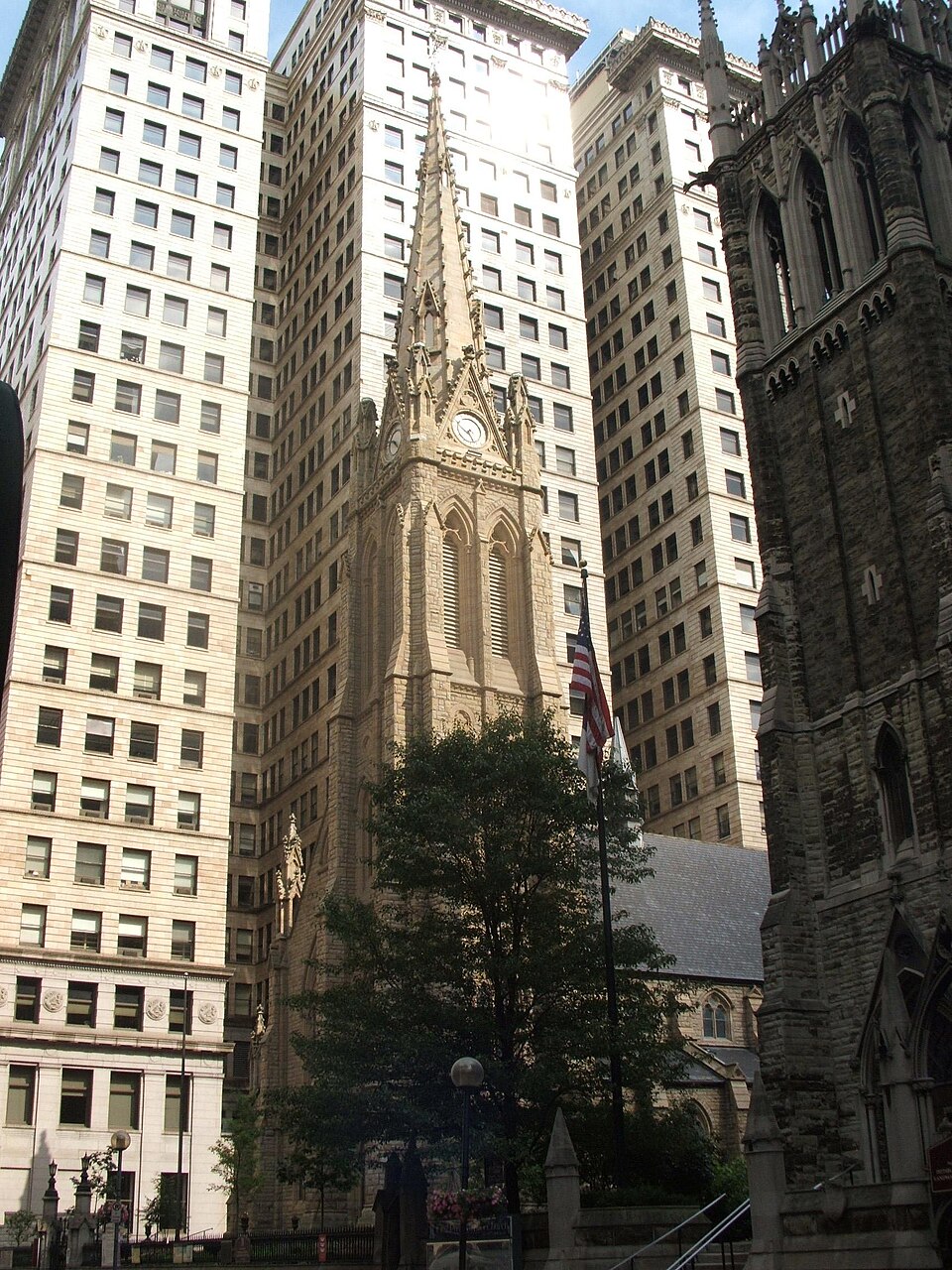

The churchyard of Trinity Cathedral, on Sixth Avenue, is the oldest burial ground still in place downtown. Before the churches, the ground was a Native burial mound. The French at Fort Duquesne buried their dead in it. The first name in their register is a soldier, Toussaint Boyer, in June 1754. After 1758 the British at Fort Pitt used the same ground. In 1787 the heirs of William Penn granted the terrace to the Episcopal congregation and to the Presbyterians next door. Trinity’s first building, a brick octagon called the Round Church, went up a block away and was finished in 1805. The congregation moved onto this yard in the 1820s. The Gothic church standing now was finished in 1872.
For a long time the yard was the whole block, raised above the street and fenced, and thousands of people were buried in it. Streets were cut through. Graves were moved into crypts under the church, and later out to other cemeteries. The Nevilles were taken to Allegheny Cemetery in 1902. A marker in the yard says as many as 4,000 people were buried here, that the books name more than 800 of them, and that 155 stones are still standing. The earliest that can still be read is Captain Samuel Dawson, died 6 September 1779. On a walk through what is left, Chief Red Pole of the Shawnee is there, and so is Dr. Nathaniel Bedford, the first physician in the town. The last burial was more than a century ago.
Walking tours treat the yard as haunted. They do not hang that on any one grave.
Sources